Few things are more frustrating than stepping into a warm shower only for the water to suddenly turn cold. If your water heater keeps running out of hot water, something in your system may need attention.
Sometimes, the problem comes from using more hot water than your system can produce. However, sediment buildup, heating element problems, incorrect settings, or an aging water heater can also reduce available hot water.
The good news is that many hot water problems can be diagnosed and corrected before the entire unit fails. Understanding the warning signs can help you decide whether you need maintenance, repair, or replacement.
For homeowners in Zephyr, Brownwood, and surrounding Central Texas communities, identifying the cause early can also prevent unnecessary inconvenience and larger plumbing problems.
Why Does My Hot Water Run Out So Quickly?
Your water heater has a limited ability to store or produce hot water at one time. Therefore, household demand plays an important role in how long your hot water lasts.
A tank water heater stores a specific amount of heated water. Once that supply is used, the heater needs time to warm incoming cold water.
A tankless unit works differently because it heats water when you need it. However, even a tankless system has a maximum flow capacity.
If several showers, faucets, or appliances require hot water simultaneously, your system may struggle to meet the total demand.
Still, frequent hot water shortages can indicate a mechanical or maintenance problem rather than normal household use.
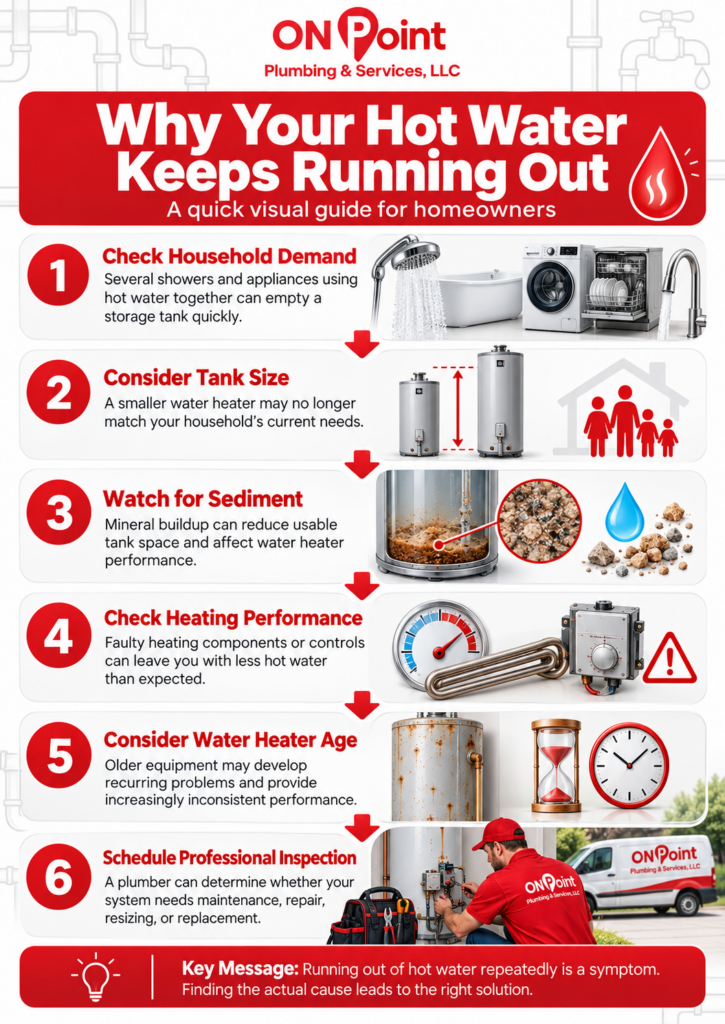
1. Your Water Heater May Be Too Small
An undersized water heater is one of the most straightforward reasons a household runs out of hot water.
Perhaps your family has grown since the current unit was installed. Alternatively, you may now use more showers, laundry cycles, and dishwashing appliances than before.
When demand exceeds your tank capacity, hot water disappears faster than the heater can replace it.
For example, several showers followed by laundry can place significant demand on a smaller storage tank.
The solution is not always buying the largest available water heater. Instead, a plumber can consider household size, usage patterns, fixtures, and available space when recommending an appropriate unit.
2. Sediment May Be Building Up Inside the Tank
Minerals naturally present in water can gradually settle at the bottom of a storage water heater.
Over time, this water heater sediment buildup can occupy space that would otherwise hold heated water. Consequently, the usable capacity of your tank can decrease.
Sediment can also contribute to unusual popping or rumbling sounds from some water heaters. ENERGY STAR identifies reduced hot water availability and unusual rumbling as possible signs associated with aging systems and sediment accumulation.
Regular maintenance may help address sediment before it creates larger performance problems.
If your water heater has never received maintenance, professional inspection can determine whether sediment is contributing to your hot water shortage.
3. A Heating Element Could Be Failing
Electric water heaters commonly use heating elements to warm water inside the tank.
If one element stops working correctly, the heater may still produce some hot water. However, the available supply might become noticeably smaller.
For instance, you may get enough hot water for a short shower but not enough for several consecutive showers.
This problem can easily be mistaken for an undersized tank because the unit continues operating rather than completely failing.
A professional plumber can inspect the heating components and determine whether repair is appropriate.
4. Your Water Heater Thermostat May Need Attention
A thermostat helps control the temperature of stored water.
When the thermostat or related controls do not operate properly, the heater may fail to maintain the expected water temperature.
As a result, you might notice water becoming lukewarm sooner or taking longer to recover after heavy use.
Avoid repeatedly increasing the temperature to compensate for unexplained performance problems. Excessively hot water increases the risk of burns and may not address the actual cause.
Instead, have the unit inspected if water temperatures become inconsistent without an obvious change in household demand.
5. Your Household May Be Using Too Much Hot Water at Once
Sometimes, the water heater is working properly but simply cannot keep up with simultaneous demand.
Consider what happens during a busy morning. One person showers while the dishwasher runs, another faucet opens, and the washing machine begins a warm cycle.
Every fixture draws from the available hot water supply.
Consequently, a properly operating tank can still run out when several hot water activities occur close together.
Spreading high-demand activities throughout the day may help. However, recurring shortages during normal use could mean your water heater needs a different capacity.
Common Hot Water Problems at a Glance
Problem | Common Sign | Recommended Action |
Water heater too small | Hot water runs out during normal household use | Review capacity and household demand |
Sediment buildup | Reduced hot water and unusual tank noises | Schedule water heater maintenance |
Heating element problem | Hot water supply becomes much shorter | Request professional inspection |
Thermostat problem | Water temperature becomes inconsistent | Have controls professionally checked |
High simultaneous demand | Hot water ends when several fixtures operate | Space out usage or review system capacity |
Aging water heater | Frequent repairs and inconsistent performance | Consider repair or replacement |
Tankless capacity issue | Water cools during simultaneous use | Check unit sizing and maximum flow demand |
6. Your Water Heater May Be Getting Older
Water heating equipment does not perform indefinitely without wear.
As a unit ages, corrosion, sediment, worn components, and declining efficiency can gradually affect performance.
An older system may begin producing less hot water, making unusual noises, leaking, or requiring repeated repairs.
ENERGY STAR advises homeowners to watch older units for warning signs, including corrosion, leaks, rusty water, reduced hot water availability, and unusual noises.
Age alone does not automatically mean replacement is necessary. However, frequent problems can make replacement worth discussing with a professional.
7. Your Tankless Water Heater May Be Overloaded
Many homeowners assume a tankless water heater can provide unlimited hot water under every circumstance.
A tankless system can continue heating water without emptying a storage tank. However, the unit still has a maximum flow capacity.
The Department of Energy explains that proper tankless sizing depends on the maximum hot water flow required at one time and the required temperature increase.
Suppose two showers and a hot water appliance operate simultaneously. If their combined demand exceeds the unit’s capacity, performance can suffer.
Therefore, recurring tankless problems may indicate incorrect sizing rather than a complete equipment failure.
8. Hot Water May Be Taking Too Long to Reach Your Faucet
Sometimes your water heater is producing enough hot water, but the delivery system creates the impression that it is not.
Long pipe runs between the water heater and distant bathrooms can leave cooled water sitting inside the pipes.
You must then run the faucet while that cooler water exits before heated water arrives.
The Department of Energy notes that piping distance and plumbing configuration affect how quickly hot water reaches fixtures.
If one bathroom takes much longer than another to receive hot water, the problem may involve distribution rather than heater capacity.
How Can You Make Your Hot Water Last Longer?
You can sometimes improve hot water availability by changing household usage patterns and maintaining your equipment properly.
Try spacing showers, laundry, and dishwasher cycles rather than running them simultaneously. Additionally, address dripping hot-water faucets because they continuously consume heated water.
Routine water heater maintenance can also help keep the system operating as intended.
If your household consistently needs more hot water than the existing unit can supply, changing usage habits may provide only temporary relief.
In that situation, discuss system capacity with a qualified plumber.
When Does Your Water Heater Need Repair?
Not every hot water shortage requires replacement.
A repair may be appropriate when the water heater is otherwise in reasonable condition, and the problem involves a serviceable component.
Consider professional water heater repair when you notice:
- Hot water becoming cold much faster than before
• Inconsistent water temperatures
• Unusual noises from the unit
• Visible moisture around connections
• Reduced hot water without increased usage
• Problems returning after basic maintenance
Do not open electrical panels or attempt internal repairs unless you are qualified to work on water heating equipment.
A professional inspection is the safer way to determine what has failed.
When Should You Consider Water Heater Replacement?
Replacement may become worth considering when an older system develops repeated problems or no longer meets your household’s needs.
For example, replacing an undersized system may improve comfort when household demand has permanently increased.
Likewise, repeated repairs on aging equipment may make a new system more practical.
Homeowners can also consider standard tank and tankless options when replacement becomes necessary. The best choice depends on household demand, available utilities, space, budget, and usage patterns.
On Point Plumbing services both standard tank and tankless water heaters and provides repair, installation, maintenance, and replacement services.
Water Heater Repair in Zephyr TX and Brownwood TX
A water heater problem can quickly interrupt showers, laundry, cooking, and cleaning.
Therefore, local service becomes especially valuable when your hot water supply changes suddenly or disappears completely.
On Point Plumbing provides water heater services in Zephyr, Brownwood, Early, Lake Brownwood, Comanche, Bangs, Dublin, and other surrounding communities. The company services multiple water heater types and offers repair, replacement, installation, and maintenance.
If you need water heater repair in Zephyr, TX, or water heater repair in Brownwood, TX, professional diagnosis can help identify the problem before you replace equipment unnecessarily.
Stop Planning Your Day Around Running Out of Hot Water
Your morning routine should not depend on who gets to the shower first.
If your water heater repeatedly runs cold, the problem may involve capacity, sediment, heating components, controls, or overall system age.
Hot water disappears halfway through your shower?
Have the water heater inspected for capacity or performance problems.
Hearing popping or rumbling sounds?
Schedule maintenance before the problem becomes more disruptive.
Tankless system struggling with several fixtures?
Ask whether your current unit matches your household’s flow requirements.
Need water heater service in Central Texas?
Contact On Point Plumbing for professional water heater repair, maintenance, installation, or replacement in Zephyr, Brownwood, and surrounding communities.
Finding the cause now can help restore dependable hot water and prevent repeated frustration.
Frequently Asked Questions
Why does my water heater keep running out of hot water?
Common causes include high household demand, an undersized tank, sediment buildup, heating component problems, or an aging water heater.
Why does my hot water run out halfway through a shower?
Your storage tank may have insufficient capacity, or the heater may not be warming the full volume of water correctly.
Can sediment make my water heater run out of hot water faster?
Yes. Sediment can accumulate inside storage water heaters and reduce the space available for heated water.
Can a tankless water heater run out of hot water?
A tankless system does not empty like a storage tank. However, hot water performance can decline when simultaneous demand exceeds its rated flow capacity.
Should I repair or replace a water heater that keeps running cold?
The right choice depends on the system’s age, condition, capacity, and repair needs. A professional inspection can determine which option makes more sense.


