


Renovating your home is exciting, with new sinks, fresh floors, and modern bathrooms. But inside those walls and under the floors… plumbing quietly waits. If it’s weak or flawed, disaster can strike weeks or months later.
You might think plumbing is a “just deal with it later” thing. But here’s the reality: a plumbing audit before remodeling can stop those disasters before they start.
In this post, we’ll talk like homeowners, not consultants. We’ll walk through what a plumbing audit really does, how it saves huge trouble, and how it ties into your remodeling plans (especially in Zephyr, TX). We’ll toss in a practical table and answer your FAQs at the end.
Let’s get into it.
What Is a Plumbing Audit and Why Do You Need One?
Imagine you start tearing into a wall, and suddenly water spurts from a corroded pipe. Or the new fixtures you planned don’t get enough water pressure. That’s what happens when your plumbing gets overlooked.
A plumbing audit is a full plumbing inspection before remodeling. It checks every water supply line, drain, vent, fixture, and pressure point. You’re not just glancing, you’re assessing condition, capacity, compliance, and risk.
Here’s what it helps with:
- Spotting hidden leaks, corrosion, or weak pipes
- Checking water pressure and flow so your new layout works
- Making sure everything meets local plumbing codes
- Planning upgrades or reroutes before walls go up
- Avoiding project delays when something fails halfway
It’s like a health check-up for your plumbing system, but the cost of skipping it is broken floors, mold, ruined finishes, and surprise repairs.
Why a Plumbing Inspection Before Remodeling Prevents Leaks and Failures
When you remodel, you change water demands, move fixtures, and disturb plumbing. Without inspection, that’s a recipe for leaks.
Here are real risks and how an audit protects you:
|
Risk |
What Often Happens |
How Plumbing Audit Prevents It |
|
Old or corroded pipes bursting |
During or after renovation, you see sudden leaks |
Audit detects weak pipes, so you replace them ahead of time |
|
Low water pressure or imbalance |
Audit measures flow and pressure so you can plan upgrades |
|
|
Non-code or patched plumbing |
Hidden shortcuts or old fixes fail under stress |
Audit finds code violations, so you fix them up front |
|
Drain or vent issues |
New bathroom drains slowly or gurgles |
Audit inspects drainage and venting for adequacy |
|
Hidden leaks behind walls or under floors |
Mold, rot, and structural damage later |
Audit uses cameras or pressure tests to locate hidden leaks |
Renovators often assume plumbing is “fine” until disaster proves otherwise. But a plumbing inspection before remodeling is exactly what prevents those surprise failures.
Why a Plumbing Audit Before Remodeling Matters
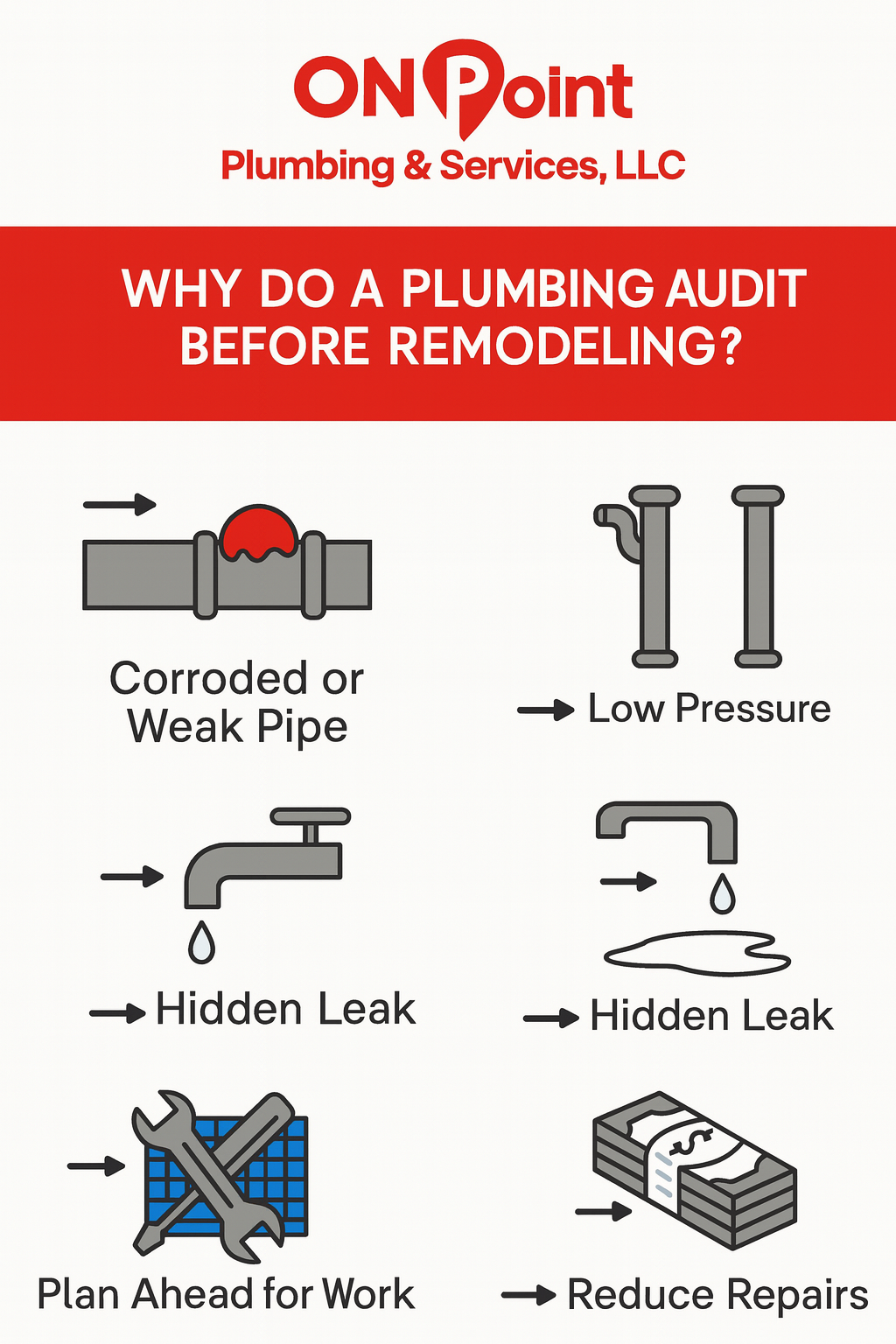
Before starting your renovation, it helps to actually see what a plumbing audit prevents. The infographic below highlights the top reasons why an inspection can save you from leaks, code issues, and costly repairs.

How a Pre-Renovation Plumbing Checklist Works for Your Home
You might wonder: “Okay, what exactly gets checked in an audit?” Below is a simplified, homeowner-friendly version of a pre-renovation plumbing checklist.
1. Visual Inspection & Documentation
Check visible pipes, fittings, valves for leaks, rust, stains, and past repairs. Take photos, take notes.
2. Water Pressure & Flow Test
Measure pressure at various faucets. Make sure the water can support multiple fixtures running.
3. Drainage Test & Camera Inspection
Test drains, run water, check for backups. Use a video camera in the main lines to see cracks or blockages.
4. Fixture & Appliance Evaluation
Check sinks, showers, toilets, and water heaters. Are they in good condition? Are the connections sound?
5. Pipe Material & Age Evaluation
Identify what your plumbing is made of (copper, PVC, PEX, galvanized). Older materials might need replacement.
6. Vent, Trap, and Code Compliance Checks
Verify vents are clear, traps are correct, slope is right. Check that your changes will meet local code.
7. Plan for Reroutes or New Zones.
Based on your remodel, plan new lines, shut-offs, and isolation valves.
8. Risk & Contingency Identification
Estimate weak spots, hidden areas to open, and include a buffer in the budget for surprises.
When followed, this checklist turns plumbing from a hidden risk into a manageable, planned part of your remodel.
Specific Benefits for Remodelers and Runners (Or Active Households)
You may ask: how does this plumbing audit connect to your lifestyle, say you’re active, using smart home gear, or doing tight scheduling? Here’s how:
- You can schedule work precisely. A plumbing audit up front helps your contractor lock in plumbing decisions early. No surprise delays.
- If you’re using smart appliances (e.g., smart showers, water monitors), you need reliable water systems. The audit ensures your infrastructure can support them.
- For people with busy lives (like training for marathons or using iFIT workouts), downtime is costly. Plumbing failures mid-project can push you offline; an audit reduces that risk.
- If resale or investment is on your mind, a documented plumbing audit increases buyer confidence.
And for homes in Zephyr, TX, where climate, soil, or local codes may strain plumbing, a local plumbing system assessment ensures your remodel fits regional realities
How a Plumbing Audit Saves You Money and Headache
Let’s talk costs and value. The upfront cost of a plumbing audit is a small fraction of what a major repair will cost.
- Avoid emergency fixes that cost 2× to 5× more than planned fixes.
- Prevent damage to finishes (drywall, flooring, cabinetry), which costs thousands.
- Reduce project delays, when contractors wait for plumbing fixes, your schedule drags
- Lower risk of mold, rot, and structural damage, which carry long-term costs
- Better budgeting and transparency, you know what you’re getting into
One homeowner shared that after asking for a plumbing audit, the plumber found a cracked drain line behind a shower wall. Fixing it before tiling saved them nearly $4,000 in demolition and delay costs.
That kind of story is not rare. It’s the difference between “what a disaster” and “that went smoothly.”
How Onpoint Plumber Helps You Do This Right
You don’t have to figure this out alone. At OnPoint Plumber, we treat plumbing audits as a core service for smart remodels.
Here’s how we approach it like people, not machines:
- We walk you through every finding, with photos. You’ll know exactly what’s happening.
- We give you layers of options: “replace now,” “monitor,” “defer”, so you control the budget.
- We align plumbing plans to your remodel timeline; nothing is discovered afterwards.
- We perform system assessments in Zephyr, TX, and nearby, so code and soil conditions are known to us.
- We make sure your plumbing will support your lifestyle (lots of showers, multiple appliances, smart plumbing, etc.).
If you’d like us to do an audit in your home, hit our contact page and let’s schedule a walk-through.
Step-By-Step How to Integrate a Plumbing Audit Into Your Remodel
To make this real, here’s a step-by-step plan you can follow.
1. Planning / Pre-Design Phase
Before finalizing the layout or fixtures, book a plumbing audit. Use findings to adapt your layout.
2. Design & Blueprinting
Your remodel drawings should incorporate plumbing audit results (reroutes, pipe placements).
3. Permit & Code Review
Submit plumbing plans with permit applications, audit ensures compliance.
4. Rough-in Plumbing
During framing, install pipes per the audited plan.
5. Testing & Pressure Checks
Before closing walls, run full pressure tests, video drain lines, and check connections.
6. Inspection / Final Plumbing
After finishing test fixtures, verify the low, and sign off.
7. Maintenance Planning
Use audit findings to plan future checks and preventive work.
If you skip step 1, you’re likely to hit problems during step 5, costly and disruptive.
What to Look for in Your Plumbing Audit Report
When your plumber gives you the audit report, these should be clear:
- Map or diagram of existing plumbing lines
- Condition notes (corrosion, pinholes, weak spots)
- Flow/pressure data
- Drain and vent camera findings
- Recommended repairs, replacements, and reroutes
- Code issues flagged
- Cost estimates, priority ranking
- Timeline implications
If any part is unclear, don’t accept it; ask the plumber. A good plumbing audit is a conversation, not a sheet you file away.
Real Life Example of Before & After Plumbing Audit
Let me walk you through a simplified real case (names and location changed):
Before Audit:
- The homeowner planned to relocate a shower and add a sink in the same bathroom.
- They assumed the existing drain and water lines would suffice.
Audit Found:
- The drain line was undersized and had a hidden partial crack.
- The water pressure was weak on the hot line when two fixtures ran.
- The venting was incorrect for the new layout.
Resulting Action:
- The plumber upgraded the drain pipe and rerouted it along a better path.
- Added a dedicated hot water line to that bathroom.
- Corrected the venting per code.
Outcome:
- The bathroom worked flawlessly. No leaks, no pressure issues.
- The project stayed on schedule.
- The cost of audit + upgrades was far less than what an emergency fix mid-project would have cost.
That’s how a plumbing audit prevented a disaster.
Ready to Remodel the Smart Way? Let Onpoint Handle the Plumbing Audit
Before you pick up a hammer, pick up the phone. A proper plumbing audit can save you thousands in future repairs and delays.
At OnPoint Plumbing & Services, LLC, our licensed experts in Zephyr, TX, specialize in pre-remodel audits, inspections, and system assessments that keep your dream renovation running smoothly.
Schedule your plumbing audit today, visit our website, and call us for a quick consultation.
Frequently Asked Questions
What is a plumbing audit, and how is it different from a normal inspection?
A plumbing audit is a full, renovation-focused inspection. It includes pressure tests, camera lines, assessing capacity, and planning for changes. A normal inspection is more about general maintenance.
How early should I schedule a plumbing inspection before remodeling?
As early as possible, ideally before your design is locked. That gives time to adjust plans.
Can I do a pre-renovation plumbing checklist myself?
Yes, you can check visible pipes, run water, look under sinks, but a professional audit gives tests, vent checks, code compliance, and a much deeper view.
Does a plumbing system assessment in Zephyr, TX cost a lot?
It depends on house size and complexity. But compared to what a leak or retrofit would cost later, it’s small.
How often should I audit plumbing after the remodel?
At least once every few years, or after heavy use changes. Use findings from your initial audit as a baseline for future checks.