


Trees add shade, beauty, and value to a property. However, their underground roots can sometimes become a serious problem for sewer pipes.
Tree roots in sewer lines can restrict wastewater flow and eventually contribute to recurring clogs, backups, and damaged plumbing. The problem often develops slowly, which means homeowners may overlook the first warning signs.
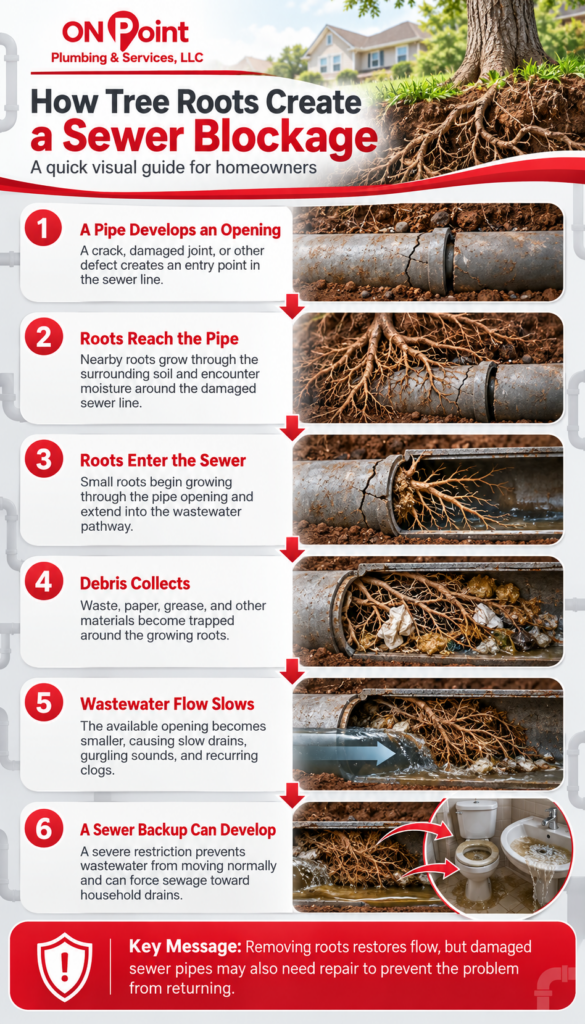
Roots commonly enter sewer lines through cracks, loose joints, or other existing openings. Once inside, they can continue growing and create increasingly serious restrictions. The Environmental Protection Agency identifies roots entering sewer defects or openings as a potential cause of sewer blockages.
Fortunately, early diagnosis can help homeowners understand the condition of the line before a complete backup occurs. Knowing the symptoms and available repair options makes it easier to respond at the right time.
How Do Tree Roots Get Into Sewer Lines?
Tree roots do not normally push directly through a perfectly sealed sewer pipe. Instead, they often enter through an existing crack, joint, opening, or damaged section.
Underground sewer pipes carry moisture and wastewater. Therefore, roots growing through nearby soil may eventually reach vulnerable sections of the line.
Once a root reaches an opening, it can grow inside the pipe. As the root system expands, waste, grease, paper, and other material can become trapped around it.
Consequently, the available space for wastewater becomes smaller. Flow slows down and the risk of a sewer blockage increases.
DC Water explains that roots entering a sewer lateral can continue growing after finding moisture, making the blockage progressively more severe.
What Are the Warning Signs of Tree Roots in Sewer Lines?
A root problem rarely announces itself with one obvious symptom. Instead, several drainage problems may develop gradually.
Watch for these common warning signs:
- Drains that repeatedly become slow
- Several drains slowing at the same time
- Toilets that clog frequently
- Gurgling sounds from sinks or toilets
- Water rising in a tub when another fixture drains
- Sewer odors inside the home
- Recurring main sewer line clogs
- Wastewater appearing near floor drains
- Previous drain cleaning that provides only temporary relief
- Sewer backups during normal water use
One slow bathroom sink may only have a local clog. However, several affected fixtures can point toward a main sewer line problem.
Recurring symptoms are especially important. If a clog returns soon after cleaning, something deeper may remain inside the sewer pipe.
Tree Root Sewer Problems at a Glance
|
Warning Sign |
Possible Problem |
Recommended Action |
|
Recurring drain clogs |
Roots or debris remain inside the line |
Schedule sewer camera inspection |
|
Several slow drains |
Main sewer line restriction |
Have the sewer line evaluated |
|
Gurgling toilets |
Restricted wastewater or airflow |
Request professional inspection |
|
Sewer odor |
Drainage or sewer line problem |
Investigate the source promptly |
|
Wastewater backup |
Major sewer blockage |
Stop water use and call a plumber |
|
Clog quickly returns |
Underlying pipe problem remains |
Use camera inspection to identify the cause |
How Do I Know If Tree Roots Are in My Sewer Line?
Symptoms alone cannot prove that roots are responsible. Grease, damaged pipes, debris, and other obstructions can create similar problems.
Therefore, a sewer camera inspection is one of the most useful diagnostic steps.
A plumber inserts specialized video equipment into the drain or sewer line. The camera allows the technician to inspect areas that cannot be seen from the surface.
Camera inspection can help identify roots, cracks, blockages, collapsed sections, or other pipe damage. It can also help determine where the problem is located.
On Point Plumbing states that it uses video inspection technology to identify blockages, clogs, and lines that may require repair or replacement.
Accurate diagnosis is important because clearing a blockage and repairing a damaged pipe are not always the same job.
Can Tree Roots Completely Block a Sewer Pipe?
Yes. Root growth can become dense enough to substantially restrict wastewater movement.
The EPA identifies tree roots as a common cause of sewer blockages. It also explains that blockages can reduce sewer capacity and contribute to backups or overflows.
As roots grow, toilet paper, grease, and other waste can become caught around them. This additional debris makes the restriction worse.
Eventually, wastewater may have nowhere to travel. It can then move backward toward the lowest available drain inside the property.
For this reason, repeated sewer symptoms should not be ignored simply because wastewater is still moving.
How Are Tree Roots Removed From Sewer Lines?
The correct method depends on the amount of root growth and the condition of the pipe.
In some situations, plumbers may use specialized drain cleaning equipment to remove roots and restore wastewater flow. However, removing roots does not automatically repair the opening that allowed them inside.
The EPA notes that cutting roots can provide temporary control but may not solve the underlying pipe defect. Root growth can return when the damaged sewer line remains accessible.
Therefore, a plumber should evaluate the pipe after clearing the immediate obstruction.
The goal is not simply to make water flow again. Instead, the underlying cause should be identified whenever possible.
When Does a Sewer Line Need Repair?
Sewer line repair may become necessary when camera inspection identifies cracks, damaged joints, openings, or other structural problems.
A minor obstruction inside an otherwise sound pipe may only require cleaning. However, repeated root intrusion suggests that roots still have a pathway into the line.
Repair can help close that entry point and reduce the likelihood of recurring root problems.
On Point Plumbing provides sewer line repair along with drain cleaning and video inspection services across Zephyr, Brownwood, and surrounding communities.
The appropriate repair method depends on the pipe material, damage location, accessibility, and overall condition.
When Is Sewer Line Replacement Necessary?
Not every root problem requires replacing an entire sewer line.
However, replacement may be considered when the pipe is severely damaged, collapsed, extensively cracked, or repeatedly failing.
Older sewer lines can sometimes have several weak areas rather than one isolated defect. In those cases, repeatedly clearing roots may only provide temporary relief.
A camera inspection can help reveal how much of the line is affected. Then, the plumber can explain whether cleaning, repair, or replacement is the better option.
The EPA recommends repairing cracked sewer lines and replacing collapsed sections to restore proper sewer capacity.

Can You Prevent Tree Roots From Damaging Sewer Lines?
No prevention method can guarantee that roots will never reach an underground sewer line. However, good property planning and plumbing maintenance can reduce risk.
First, know approximately where your sewer lateral runs before planting large trees. Avoid placing trees directly above or very close to vulnerable sewer components.
The EPA advises avoiding trees and shrubs around septic drain lines because roots can grow into and damage underground piping.
Additionally, pay attention to recurring drainage symptoms. A sewer line problem is easier to evaluate before wastewater begins backing up indoors.
Consider these practical steps:
- Know the location of your sewer line.
- Avoid planting large trees directly above sewer piping.
- Investigate recurring drain problems quickly.
- Schedule camera inspection when clogs repeatedly return.
- Avoid flushing wipes and other unsuitable materials.
- Keep cooking fats and grease out of drains.
- Repair known sewer pipe defects before they worsen.
Preventing debris from entering the sewer is also valuable because roots can capture materials that would otherwise move through the pipe.
Tree Root Sewer Line Damage in Central Texas
Homes across Central Texas often have mature landscaping and underground plumbing systems that may remain out of sight for decades.
Therefore, homeowners should pay attention when drainage performance changes unexpectedly. Recurring sewer problems deserve particular attention when trees grow near the sewer route.
On Point Plumbing provides sewer and drain services in Zephyr, Brownwood, Early, Lake Brownwood, Comanche, Bangs, Dublin, and other surrounding communities. Its services include drain cleaning, video inspection, maintenance, and sewer line repair.
Homeowners searching for sewer line repair in Zephyr, TX, sewer services in Brownwood, TX, or sewer and drain services in Central Texas can request professional evaluation before repeated clogs become more disruptive.
Stop Treating the Same Sewer Clog Again and Again
A clog that repeatedly returns may be telling you something important about the condition of your sewer line.
Drains slowing throughout the house?
Have the main sewer line inspected rather than treating every fixture separately.
Clog keeps returning after cleaning?
Request a sewer camera inspection to identify roots, damage, or another obstruction.
Seeing signs of a sewer backup?
Reduce water use and contact a plumber before additional wastewater enters the system.
Need sewer line service in Central Texas?
Contact On Point Plumbing for professional sewer and drain services in Zephyr, Brownwood, and surrounding communities. The company can be reached at 325 603 1230.
Finding the cause early can help you choose the right solution instead of repeatedly clearing the same symptom.
Frequently Asked Questions
How do I know if tree roots are in my sewer line?
Recurring clogs, several slow drains, gurgling toilets, sewer odors, and backups can indicate a main line problem. A camera inspection can confirm whether roots are present.
Can tree roots break sewer pipes?
Roots commonly enter existing defects or openings. As they grow, they can contribute to more severe restrictions and further problems around damaged pipe sections.
Can tree roots be removed without replacing the sewer line?
Sometimes. Professional equipment may clear root growth when the pipe remains structurally usable. However, damaged sections may still require repair to prevent recurring intrusion.
Will tree roots grow back after drain cleaning?
They can return when the pipe opening remains accessible. Root removal can restore flow temporarily without correcting the underlying structural defect.
When should I call a plumber about sewer roots?
Call when clogs repeatedly return, several drains slow together, toilets gurgle, sewage odors appear, or wastewater begins backing up into the property.