


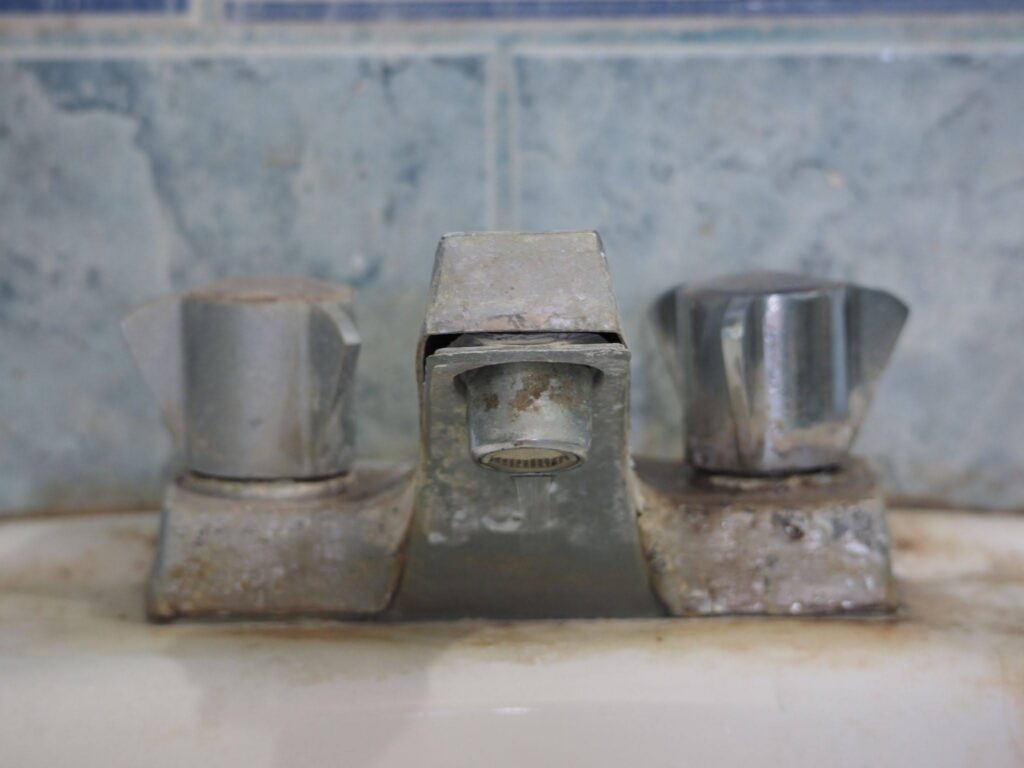
White spots and chalky deposits around your faucets can make even a clean bathroom or kitchen look neglected. More importantly, white buildup around faucets may tell you something useful about the water flowing through your plumbing system.
In many homes, this residue develops when water containing dissolved minerals dries on faucets, sinks, showerheads, and other fixtures. Over time, these minerals create visible deposits that become increasingly difficult to remove.
Although surface deposits may initially seem cosmetic, repeated hard water buildup can also affect faucet aerators, showerheads, appliances, and plumbing performance. Therefore, understanding the cause can help homeowners choose an appropriate solution instead of repeatedly cleaning the same stains.
For homeowners dealing with recurring mineral deposits, professional water testing and water treatment may help identify the underlying issue. On Point Plumbing offers water purification and hard water treatment-related services in Zephyr and surrounding Central Texas communities.
What Causes White Buildup Around Faucets?
The most common cause of white buildup around faucets is hard water. Hard water contains dissolved minerals, particularly calcium and magnesium.
When water reaches your faucet and evaporates, the water disappears while some dissolved minerals remain behind. Consequently, repeated wetting and drying gradually creates the chalky residue you see around faucet bases and spouts.
This material is commonly described as mineral scale, limescale, or calcium buildup on faucets. You may notice it anywhere water repeatedly touches and dries on a surface.
On Point Plumbing explains that hard water contains dissolved minerals such as calcium and magnesium. Its water purification service also notes that mineral accumulation can eventually reduce water flow and affect plumbing fixtures or appliances.
How Can You Tell If the White Residue Is Hard Water Buildup?
White residue alone does not provide a complete water quality diagnosis. However, several symptoms appearing together can make hard water a likely explanation.
Look around your kitchen, bathrooms, laundry area, and water-using appliances for these signs:
- White crust around faucet openings
- Chalky residue near faucet bases
- Spots on glassware after washing
- Scale around showerheads
- Reduced flow from faucet aerators
- Mineral deposits around sink surfaces
- Recurring stains on plumbing fixtures
- Sediment-related problems in water heaters
- Scale on appliances that regularly use water
If the deposits return shortly after cleaning, your water may contain enough minerals to create recurring scale. A water hardness test can provide clearer information about the mineral concentration.
White Faucet Buildup at a Glance
What You Notice | Possible Cause | What to Consider |
White crust around faucet | Hard water minerals | Clean the fixture and assess water hardness |
Reduced faucet flow | Scale inside the aerator | Remove and inspect the aerator |
Cloudy spots on glassware | Mineral residue after drying | Consider water hardness testing |
Scale around showerhead | Repeated mineral accumulation | Clean compatible surfaces and inspect flow |
Buildup returns quickly | Ongoing hard water exposure | Explore professional water treatment |
Multiple fixtures affected | Whole home water hardness | Discuss water softening options with a professional |
Can Hard Water Damage Faucets?
Hard water does not usually destroy a faucet overnight. However, repeated mineral buildup on faucets can interfere with smaller openings and moving components over time.
For example, faucet aerators contain small screens that regulate water flow. Mineral deposits can accumulate around these openings and gradually restrict the amount of water passing through them.
As a result, the faucet may begin producing an uneven stream or weaker flow. Cleaning the aerator can sometimes improve performance if mineral scale is responsible.
However, exterior cleaning alone will not prevent the buildup from returning when hard water remains untreated. Therefore, recurring deposits may justify looking beyond the faucet itself.
Hard water scale can also affect other plumbing equipment. On Point Plumbing notes that scale accumulation can contribute to plumbing concerns and affect appliances including water heaters and dishwashers.
Is White Residue on Faucets Dangerous?
Visible white mineral residue is commonly associated with minerals in hard water rather than automatically indicating dangerous contamination. However, appearance alone cannot establish whether your water contains other substances.
Water hardness and water purity are also different concerns. A water softener primarily addresses minerals responsible for hardness, while filtration systems may target different water quality concerns.
Therefore, homeowners worried about drinking water quality should avoid diagnosing water safety based solely on faucet deposits. Professional water testing can provide more useful information about the water itself.
On Point Plumbing states that it provides water testing for commercial customers and offers reverse osmosis, filtration, purification, softening, and hard water-related solutions.
How to Remove Calcium Buildup From Faucets
Light surface deposits can often be managed through routine fixture cleaning. However, always consider the faucet manufacturer’s care instructions before using acidic or abrasive products.
Start by wiping the faucet with a soft cloth and an approved fixture cleaner. Then, pay attention to seams, faucet bases, handles, and the aerator where deposits commonly accumulate.
For finishes that tolerate it, diluted household vinegar is sometimes used to loosen mineral scale. However, acidic cleaners can damage certain specialty finishes or surrounding stone surfaces.
Therefore, confirm that any cleaning solution is compatible with your fixture before applying it. Avoid aggressive scraping because abrasive tools can scratch or permanently dull the finish.
If the aerator has restricted flow, removing and cleaning it may help. Nevertheless, a damaged or heavily scaled component may need replacement rather than repeated cleaning.
How Can You Prevent Mineral Buildup on Faucets?
Regular cleaning can reduce visible deposits. However, preventing repeated faucet mineral deposits requires attention to both your fixtures and your water.
Consider these practical steps:
- Dry faucets after heavy water use
- Clean fixtures before thick scale develops
- Inspect and clean faucet aerators periodically
- Check showerheads for restricted openings
- Follow manufacturer instructions when choosing cleaners
- Test your water if deposits return frequently
- Consider water softening when hardness is significant
- Ask a plumber about recurring low flow or fixture problems
Additionally, check appliances that regularly heat or use water. Mineral accumulation can become especially noticeable where water is repeatedly heated or evaporated.
Could Hard Water Affect Your Water Heater?
Hard water concerns do not necessarily stop at faucets. Minerals can also settle in equipment that stores or heats water.
Over time, sediment may collect inside certain water heaters. Depending on the system and conditions, this buildup can contribute to noises or declining performance.
Therefore, visible scale throughout your home may be worth discussing during water heater maintenance. A plumber can evaluate whether maintenance, water treatment, or another solution is appropriate.
On Point Plumbing provides water heater installation, repair, and maintenance alongside its water purification services.
Water Softening and Water Purification Are Not the Same Thing
Homeowners sometimes use water softening and water purification as interchangeable terms. However, they perform different jobs.
A water softener is designed primarily to address hardness minerals such as calcium and magnesium. Consequently, softening can help reduce the scale associated with hard water buildup.
Water filtration and purification systems can address different water quality goals depending on the technology used. Reverse osmosis systems, for example, operate differently from conventional water softeners.
On Point Plumbing offers reverse osmosis water purification and water softener-related services. The company also provides hard water treatment information for homeowners concerned about scale and mineral accumulation.
Hard Water Solutions Central Texas Homeowners Can Explore
Water hardness varies according to the mineral content of the water source. Therefore, the most appropriate solution depends on your actual water conditions and household needs.
If white crust appears on several fixtures throughout your home, begin by identifying whether hardness is responsible. Testing can help you understand the issue before investing in treatment equipment.
Depending on the results, a professional may discuss softening, filtration, purification, fixture maintenance, or a combination of solutions.
Homeowners looking for water purification services in Central Texas can also compare treatment options based on their specific water concerns. On Point Plumbing lists water purification services across Zephyr, Brownwood, Early, Lake Brownwood, Comanche, Bangs, Dublin, and other surrounding communities.
When Should You Call a Plumber?
A little surface scale does not always require a plumbing repair. However, professional help becomes useful when the symptoms extend beyond cosmetic residue.
Consider calling a plumber when:
- Several faucets have significantly reduced flow
- Mineral deposits return very quickly
- Aerators repeatedly become clogged
- Plumbing fixtures are deteriorating
- Your water heater shows performance problems
- You want to test or treat hard water
- You need help selecting a water treatment system
A professional evaluation can help distinguish a fixture problem from a broader water quality issue.
Stop Cleaning the Same White Buildup Again and Again
White deposits may keep returning because cleaning addresses the visible residue rather than the water conditions creating it.
If white buildup around faucets has become a regular problem, consider investigating your water instead of repeatedly scrubbing every fixture.
1. Seeing white crust around faucets?
Check for similar deposits around showerheads and other fixtures.
2. Noticing weaker water flow?
Inspect the faucet aerator and consider professional plumbing help.
3. Finding mineral scale throughout your home?
Ask whether hard water testing and treatment could help.
4. Need professional water treatment guidance?
Contact On Point Plumbing to discuss water purification and hard water solutions for Zephyr and surrounding Central Texas communities. The company offers water purification systems and water softener-related services.
Frequently Asked Questions
What causes white buildup around faucets?
White buildup is commonly caused by calcium, magnesium, and other dissolved minerals left behind after hard water evaporates. Repeated evaporation gradually produces visible mineral scale.
Is white buildup on faucets caused by hard water?
Hard water is a common explanation, especially when similar scale appears on showerheads, sinks, glassware, and other water-exposed surfaces.
How do I remove calcium buildup from faucets?
Use a soft cloth and a cleaner approved for your faucet finish. Compatible fixtures may tolerate diluted vinegar, but always check manufacturer instructions first.
Can hard water reduce faucet water pressure?
Mineral scale can restrict small openings inside faucet aerators and showerheads. Consequently, heavily accumulated scale may contribute to weaker or uneven water flow.
How can I prevent white residue from coming back?
Regular cleaning and drying can control surface deposits. However, recurring buildup may require water hardness testing and an appropriate water treatment solution.